
Introduction
Small theater lighting often looks simple from the audience, but anyone who has worked behind the scenes knows how challenging it can be. Limited rigging positions, shallow stages, tight budgets, and a small number of fixtures make it difficult to apply traditional theater lighting setups.
These constraints can quickly turn basic lighting tasks into frustrating problems—actors stepping out of light, harsh shadows on the back wall, or cues that are too complex for volunteer operators to run smoothly.
In this guide, we focus on the real challenges small theaters face and provide practical solutions that actually work in limited spaces. You'll learn five lighting strategies designed specifically for small stages—techniques that help you create depth, focus, and atmosphere even with minimal equipment.

Solution 1: Work With Your Rigging Limits — Not Against Them
Challenges addressed
- Limited rigging positions
- Low ceilings that break standard lighting angles
- No space to hide equipment or mistakes
The core issue
When your theater has only a few hanging points, a ceiling height of around 2.5 meters, and no side lighting positions, traditional lighting layouts simply stop working. Trying to recreate a full professional rig often leads to awkward angles, uneven coverage, and visible equipment.
Instead of forcing a standard setup, small theaters benefit from designing around the positions that actually exist.
Practical approaches
-
Use the “closest useful angle” principle
If ideal lighting angles aren't possible, place fixtures as close as possible above the acting area. Slightly imperfect angles are often better than actors stepping in and out of light. -
Focus on key performance zones instead of the whole stage
In small venues, audiences naturally focus on where the actors are. Lighting two or three key zones often works better than trying to evenly illuminate the entire stage. -
Replace traditional side lighting with mobile booms
If there are no built-in side-light positions, portable side-light stands placed at floor level can still create body shape and separation without requiring extra rigging. -
Use unconventional mounting points
Walls, floor mounts, and even structural elements around the audience can become viable lighting positions—as long as the fixtures remain secure and out of the audience's direct sightline. One advantage of black box spaces is flexibility.
Case Example: Basement Theatre, Auckland
Basement Theatre in Auckland operates in a former industrial space with a ceiling height of only about 2.5 meters. Traditional overhead lighting rigs were difficult to install.
To adapt, the theater introduced compact LED strip fixtures that could be mounted both vertically and horizontally. These fixtures served multiple roles—front wash, backlight, or effect lighting depending on the scene.
As technical manager Michael Trigg noted, flexibility became the most important requirement for every lighting fixture in the space.
Solution 2: Make Silence a Design Priority
Challenges addressed
- Fixture noise disrupting quiet scenes
- Audience proximity amplifying technical flaws
The core issue
In a 100–150 seat theater, lighting fixtures may be only a few meters away from both the audience and the performers. Even moderate fan noise can become noticeable during quiet dialogue or monologues.
Practical approaches
-
Choose low-noise or fanless fixtures whenever possible
For theater environments, fixture noise should ideally remain below about 35–40 dB at one meter. -
Use noisy fixtures only when necessary
Moving lights or effect fixtures can be reserved for moments that require motion or dynamic lighting, while quieter fixtures handle dialogue scenes. -
Test fixtures with spoken dialogue
Play a recorded monologue while evaluating lighting equipment. If the fixture noise competes with the voice, it may not be suitable for small venues. -
Watch for relay and dimming noise
Mechanical clicks during color changes or dimming can also become audible in quiet scenes.
Case Example: National Theatre of Greece — When Silence Matters
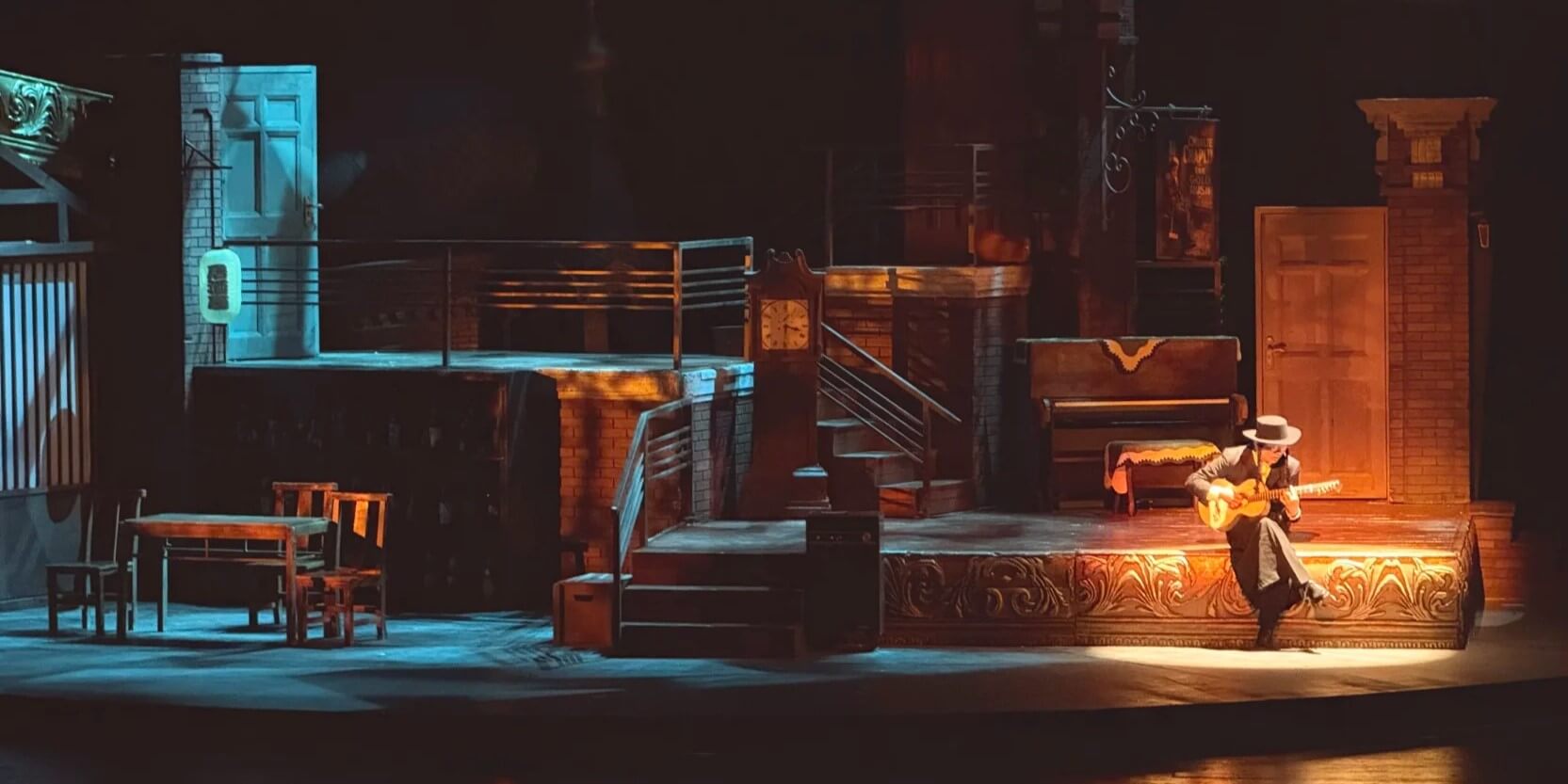
During the 2023 stage musical Charles Tante at Fredericia Musicalteater in Denmark, lighting designer Per Toft Lehmann faced a challenge common in traditional theater spaces: lighting fixtures had to be powerful enough for musical numbers, but quiet enough not to interfere with dialogue.
Because the venue relied heavily on spoken scenes and close audience proximity, fixture noise was a serious concern. Lehmann specifically searched for lighting instruments that could operate with minimal fan noise while still providing enough output and flexibility for both spot lighting and scenic effects.
The final rig used compact profile fixtures installed on overhead lighting bars and front-light positions. Their low noise level allowed the production to maintain a clear theatrical atmosphere during dialogue-heavy scenes while still delivering dynamic lighting effects when needed.
Solution 3: Let Lighting Replace Scenery
Challenges addressed
- Minimal scenery
- Limited fixtures
- Small stage depth
The core issue
In many small theaters, there simply isn’t enough space—or budget—for complex set changes. Black box stages and community venues often rely on minimal scenery, which means the environment of a scene must be created in other ways.
Lighting becomes the fastest and most flexible tool for defining space.
Practical approaches
-
Use color to define different locations
Warm ambers can suggest interiors or daylight, while cooler blues and greens can quickly create night or outdoor environments. -
Create visual boundaries with light
Instead of building physical walls or structures, use focused light to define where a scene takes place. A narrow pool of light can instantly turn part of the stage into a separate location. -
Layer textures with gobos or soft patterns
Simple patterns projected onto the floor or backdrop can suggest environments such as parks, streets, or interior windows without requiring large scenic elements.
Case Example: Creating Multiple Locations on a Minimal Stage
In a small black box production of a one-act drama, the set consisted of only a table and two chairs. Instead of building multiple scenic elements, the lighting design used three distinct color environments: a warm amber wash for interior dialogue scenes, a cool blue state for nighttime moments, and a textured green pattern to suggest an outdoor park.
With only a few lighting changes, the audience could clearly distinguish between locations—even though the physical set never changed.
Solution 4: Design for the Volunteer Operator
Challenges addressed
Limited access to experienced lighting operators
Community theaters often rely on volunteers
The core issue
Many small theaters depend on volunteers to run lighting during performances. The lighting designer may understand the system perfectly, but the person operating the console on show night might be a teacher, student, or last-minute substitute.
When lighting systems rely on complex cue stacks or manual timing, mistakes become much more likely.
Designing a system that is simple and intuitive can dramatically reduce show-night errors.
Practical approaches
-
Use preset scenes instead of long cue lists
Programming a small number of clearly labeled scenes—such as Day Interior, Night Scene, or Finale—can be easier to manage than dozens of numbered cues. -
Simplify the control interface
Tablet-based DMX apps or simplified control surfaces are often easier for occasional operators to learn than complex lighting desks. -
Reduce the number of lighting changes
Not every scene transition requires a lighting cue. Focusing on the most important emotional moments keeps operation manageable. -
Label cables and equipment clearly
Color-coded cables or labeled circuits make troubleshooting much faster during rehearsals. -
Walk the operator through the show before curtain
Instead of explaining the technical details of every cue, describe the emotional intent of each scene so operators understand when transitions should happen.
Solution 5: Turn Close Quarters Into an Advantage
Challenges addressed
Audience proximity that exposes every flaw
Shallow stage depth that limits large visual effects
The core issue
In small theaters, the audience may sit only a few meters from the stage. Lighting that works well in large venues can feel harsh or exaggerated in such close quarters. But this proximity can also become an advantage—subtle lighting choices are far more noticeable and emotionally effective.
Instead of trying to imitate the scale of large productions, lighting can focus on clarity, detail, and atmosphere.
Practical approaches
-
Use cross-lighting to enhance facial expressions
Lighting from both sides of the stage can shape actors’ faces and make subtle expressions easier for nearby audiences to read. -
Allow darkness to guide attention
Leaving parts of the stage in shadow helps focus the audience on the performer rather than the entire stage. -
Use practical light sources
Table lamps, candles, or small LED bulbs placed within the set can create natural lighting while also supporting the scene visually. -
Use slow fades instead of abrupt transitions
In intimate spaces, gradual lighting transitions often feel more natural and less distracting than quick changes. -
Layer warm and cool lighting to create depth
Combining warm front light with cooler backlight can help separate performers from the background and make a small stage feel larger.
Budget Lighting Setup Examples for Small Theaters
Every theater has different needs, but even a modest budget can build a flexible lighting setup. Below are three example configurations that small theaters often use depending on their available budget.
$1000 Budget Setup — Basic Wash Lighting
For very small theaters, rehearsal spaces, or black box venues, the priority is creating even stage visibility and simple color atmosphere.
Typical setup:
- 4 × LED PAR wash lights for front lighting and stage wash
- 1 basic DMX controller
- 2 small lighting stands
This setup allows basic scene lighting, simple color changes, and enough visibility for actors while remaining affordable.
Compact wash fixtures such as the Betopper 18×18W RGBWA+UV LED PAR Light are commonly used in these setups because they provide strong color mixing and flexible mounting options.
$3000 Budget Setup — Small Theater Production Rig
With a slightly larger budget, theaters can introduce beam effects and dynamic lighting while maintaining a solid stage wash.
Typical setup:
- 4 × LED PAR lights for stage wash
- 2 × moving head beam lights for effects and backlighting
- 1 DMX controller
- basic truss or lighting stands
Moving head fixtures add motion, highlight dramatic moments, and help create visual separation between performers and the background.
Compact beam fixtures such as the Betopper 150W LED Beam Moving Head Light can produce narrow beams and prism effects that add depth even on smaller stages.
$5000 Budget Setup — Full Small Theater Lighting System
A larger budget allows theaters to combine wash lighting, beam effects, and gobo projections to create richer environments.
Typical setup:
- 6 × LED PAR lights for front and side washes
- 2 × beam moving heads for aerial effects
- 2 × gobo-capable beam fixtures for texture and scenic projection
- DMX controller or lighting console
Fixtures with gobo wheels allow designers to project patterns such as windows, foliage, or architectural textures, helping transform a minimal stage into multiple environments without building scenery.
High-output fixtures like the Betopper 9R 260W Beam Moving Head Light are often used for this purpose because their strong beam and gobo options can create dramatic stage visuals.
Conclusion
Explore lighting solutions designed for small theaters: https://betopperdj.com/
Compact fixtures, quiet operation, and flexible mounting options can make a big difference in intimate performance spaces.


コメントを残してください
全てのコメントは、掲載前にモデレートされます
このサイトはhCaptchaによって保護されており、hCaptchaプライバシーポリシーおよび利用規約が適用されます。