
Introduction
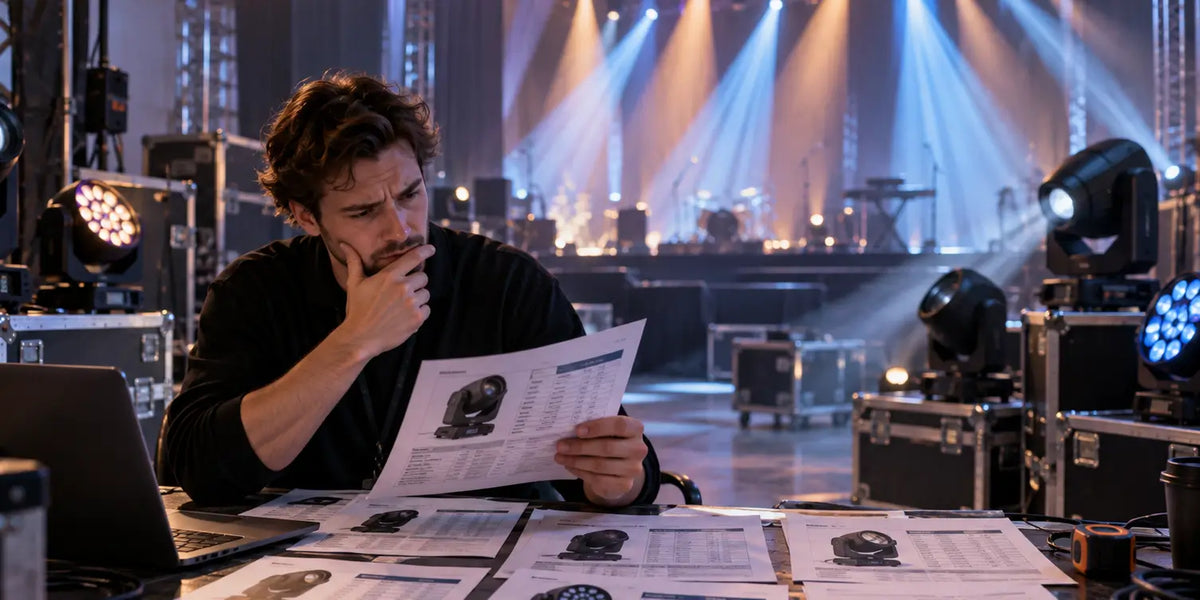
Buying a stage light isn't as simple as choosing the fixture with the highest wattage, the most DMX channels, or the longest feature list. Those numbers can be useful, but they don't tell you whether a fixture is right for your stage.
The better question is: What do you need the light to do?
A wedding, theater, DJ setup, church, corporate event, and outdoor production can all need very different things from a fixture. Once you know the job, the specification sheet becomes much easier to read.
Quick Answer
Don't choose a stage light by finding the fixture with the biggest numbers. Match the fixture to the job first, then prioritize the specifications that directly affect how it will perform in your environment.
- For broad stage coverage and wash: Prioritize beam angle, usable output, color quality, and zoom flexibility.
- For beams, aerial effects, and long throws: Prioritize narrow optics, measured output at a stated distance, Pan/Tilt performance, and effects.
- For weddings, churches, theaters, and corporate events: Prioritize color quality, smooth dimming, low operating noise, and appropriate control.
- For photography, livestreaming, and video: Prioritize CRI/TLCI, flicker performance, dimming behavior, and white-light quality.
- For outdoor productions: Prioritize IP rating, output, throw distance, construction, and the actual environmental conditions where the fixture will operate.
The goal isn't to find the fixture with the most impressive specification sheet. It's to find the one with the specifications that solve your particular lighting problem.
Start With the Job, Not the Specification Sheet
Before comparing numbers, decide what role the fixture needs to perform.
A wash is designed to cover an area with broad, relatively even light. A beam concentrates light into a narrow output for aerial effects and longer throws. A spot is useful when you need more defined projection, such as gobos. A moving head adds positioning and movement, while a hybrid combines several functions in one fixture.
This distinction matters because a specification that is valuable for one fixture may mean very little for another.
For example, a narrow beam with high intensity can be excellent for a concert effect but unsuitable for evenly lighting a wedding backdrop. A fixture with extensive animation effects may be unnecessary if your main requirement is quiet, consistent front light.
Before you compare two fixtures, answer three questions:
What am I lighting?
A person, stage, wall, backdrop, dance floor, or outdoor structure?
How far away will the fixture be?
Throw distance can change which beam angle and output you need.
What should the light actually do?
Cover an area, create a beam, project a gobo, move around the stage, or combine several effects?

The 5 Optical Specs That Actually Change the Light
1. Beam Angle
Beam angle determines how widely the light spreads.
A narrow beam concentrates light into a smaller area, making it useful for aerial effects, defined beams, and longer throws. A wider beam spreads the output over a larger area, making it more useful for washes, walls, backdrops, and shorter-distance applications.
Neither is automatically better.
A 4° beam and a 40° wash are designed to do fundamentally different jobs. Comparing them simply by which one produces the higher lux number misses the point.
Think about coverage first, then brightness.
2. Light Output: Lux vs. Lumens vs. Wattage
This is one of the easiest places to get misled by a specification sheet.
Wattage describes electrical power consumption. It does not directly tell you how much useful light reaches your subject.
Lumens describe total luminous output, but they don't tell you how concentrated that light is.
Lux describes illuminance at a surface, which makes it more useful for understanding what reaches a target—but only when the measurement conditions are clear.
For example:
100,000 lux @ 5 m
is much more useful than simply:
100,000 lux
The measurement distance matters.
Beam angle matters too. A narrow-beam fixture can produce a much higher lux reading than a wide wash because the light is concentrated into a smaller area. That doesn't automatically make the beam a better or brighter fixture for every application.
When comparing output, check:
- Measurement distance
- Beam angle
- Test conditions
- Measurement method
- Intended application
Never compare one fixture's lux @ 5 m with another fixture's lux @ 1 m as if they were equivalent.
3. Color System and Color Quality
Look beyond the number of colors a fixture can produce.
RGB provides basic color mixing. RGBW adds a dedicated white source. RGBWA+UV expands the available color and UV effects, while CMY/CTO systems offer a different approach to color mixing and color-temperature control.
But color range is only part of the picture.
For weddings, churches, theaters, corporate events, photography, and livestreaming, also consider CRI and TLCI. These measurements help evaluate how naturally colors—particularly skin tones—are reproduced.
A fixture can produce highly saturated colors and still require closer evaluation when you're using its white light for people on camera.
For camera-critical work, ask for the actual CRI/TLCI information for the fixture and the relevant white-light setting. Also test the fixture with the cameras and settings you'll actually use.
4. Zoom Range
Beam angle tells you how wide the output is; zoom tells you how much that width can change.
A fixed-beam fixture can work perfectly well when its job and installation distance are predictable. A zoom fixture provides more flexibility when you need different beam widths from the same fixture.
For example, a moving wash with motorized zoom can be used for a tighter look in one cue and broader coverage in another without physically repositioning the fixture.
The value of zoom depends on how often your application changes. If one fixture has one fixed job, you may not need it. If the same fixture needs to perform several roles, zoom can be a useful advantage.
5. Throw Distance
Throw distance asks a simple question:
Can the fixture deliver useful light to the target from where it is installed?
It's affected by more than wattage. Output, beam angle, target size, ambient light, and distance all influence the result.
A narrow beam can retain greater intensity over distance because the light is concentrated. A wide wash spreads the output over a larger area.
This is why a fixture that looks powerful in a product photo may perform very differently when installed farther away.
For a high-ceiling venue or outdoor stage, consider the actual distance from the fixture to the target before deciding which output and beam angle you need.
The 5 Control & Performance Specs That Matter
6. Pan & Tilt
For moving heads, Pan and Tilt determine where the fixture can point.
Think about two separate characteristics:
Range: Where can the fixture point?
Speed: How quickly can it get there?
Fast movement can be useful for energetic DJ and concert effects. Smooth, controlled movement may be more important for theater, corporate events, or programmed transitions.
Don't choose a moving head simply because its movement is faster. Consider whether the movement characteristics suit the type of show you're creating.
7. DMX Channels & Control Modes
More DMX channels don't automatically mean a better fixture.
A simpler DMX mode may be easier to learn and program, while a higher-channel mode can provide more detailed control over movement, effects, pixels, or other functions.
Before buying, check:
- Available DMX modes
- Channel count for each mode
- DMX addressing
- Fixture profiles
- Standalone control options
- Master/Slave, if needed
- Wireless DMX, if needed
The right question isn't:
How many channels does it have?
It's:
How much control do I actually need?
If you're learning DMX, a fixture with a manageable channel mode can be easier to understand. If you're building a complex show, additional control may be worth the extra programming effort.
8. Effects: Gobo, Prism, Frost & Animation
Effects can dramatically change what a fixture is capable of, but more effects don't automatically make a fixture more useful.
Gobo projects a pattern.
Prism splits the beam into multiple outputs.
Frost softens and broadens the effect.
Animation can create moving textures or patterns.
Think about the actual show. If you need a clean wash, elaborate animation may not matter much. If you're programming a DJ or concert rig, gobo, prism, animation, and movement may be much more important.
Choose effects based on what you'll actually use, not how long the feature list looks.
9. Noise
Noise is easy to overlook until you're standing next to a fixture during a quiet part of a show.
A fan or motor that is barely noticeable in a nightclub can become distracting during a theater performance, wedding ceremony, church service, corporate presentation, or livestream.
When noise matters, don't judge it only from a product description. If possible, evaluate the fixture at the output level you'll actually use and in an environment similar to your venue.
The quieter fixture isn't always the better fixture for every application, but noise should be part of the decision when the audience is close to the equipment or microphones are nearby.
10. Operating Environment & Camera Requirements
The final consideration is where and how the fixture will actually be used.
For outdoor productions, check the fixture's IP rating, construction, connectors, operating temperature range, and manufacturer's environmental requirements.
An IP rating describes specific levels of protection against solids and water under defined test conditions. IP65 does not mean a fixture can be exposed to every weather condition without limits.
For camera-based productions, evaluate:
- CRI / TLCI
- Flicker behavior
- Dimming performance
- Frame rate
- Shutter settings
- White balance
- Actual camera image
A fixture can look excellent to the human eye and still require testing before it becomes part of a camera-critical production.
Which Specifications Matter Most for Your Application?
The most important specifications change with the job. A useful way to prioritize them is to separate Must-Have features from Nice-to-Have features.
| Application | Must-Have | Nice-to-Have | What to Avoid |
|---|---|---|---|
| Wedding | Color quality, smooth dimming, low noise | Gobo, prism, animation, wireless DMX | Harsh white light, distracting fan noise |
| Church / Worship | Coverage, color quality, quiet operation | Zoom, subtle movement | Stepped dimming, noisy operation |
| Corporate Event | Camera performance, color quality, low noise | CMY/CTO, controlled movement | Visible flicker, distracting noise |
| DJ / Club | Output at distance, movement, dynamic effects | Zoom, pixel effects | Paying for features you won't use |
| Theater | Color quality, quiet operation, smooth dimming | Zoom, gobo, animation | Stepped low-end dimming, distracting noise |
| Outdoor Event | IP rating, output, throw distance | Wireless DMX, zoom | Indoor-rated fixtures exposed to weather |
| Concert Stage | Output, movement, beam control | CMY/CTO, animation, pixel control | Low-output wide washes used as long-throw beams |
For example, a wedding fixture may benefit more from good white-light quality, smooth dimming, and low noise than from an elaborate animation system.
A DJ fixture may have the opposite priority: movement, beam control, output, and effects can matter more than ultra-quiet operation.
The goal is not to buy every feature. It's to invest in the features that affect the result your audience will actually see and hear.
How to Compare Two Stage Lights Without Getting Lost in Specs
When two fixtures look similar on paper, don't immediately compare their biggest numbers.
Step 1: Compare the Same Type of Fixture
A beam and a wash distribute light differently. Their lux readings shouldn't be treated as a simple quality ranking.
Step 2: Compare Beam Angle
Ask whether you need concentrated output, broad coverage, or the flexibility to do both.
Step 3: Compare Output Under Comparable Conditions
Look at the measurement distance and test conditions. A number without its measurement context tells you very little.
Step 4: Compare Useful Control
Look at DMX modes, channel count, Pan/Tilt, zoom, and effects—but only the functions that matter to your application.
Step 5: Check the Environment
For a theater, noise may be a deciding factor. For an outdoor event, IP protection may matter more. For a livestream, camera performance may outrank both.
A Real-World Example: 19 × 15W Wash vs. 36 × 3W RGB Fixture
Consider a 19 × 15W RGBW wash moving head and a 36 × 3W RGB fixture.
At first glance, comparing the LED wattage alone seems tempting: 19 × 15W versus 36 × 3W. But that doesn't tell you which fixture will perform better.
The Betopper LM1915R, for example, is a moving wash with RGBW output, a 20°–40° motorized zoom, and 540° Pan / 270° Tilt. The LF80R uses 36 × 3W RGB LEDs, a focused 4° beam, and 48-zone control.
These fixtures have fundamentally different optical designs and intended uses.
The LM1915R is designed to provide broader moving wash coverage, while the LF80R's narrow 4° output and zone control are suited to concentrated effects and pixel-style programming.
So even if one fixture has a higher total LED wattage, that doesn't automatically tell you which one will produce more useful light for your application.
The same principle applies to lux. A narrow 4° output can produce a much higher spot lux reading than a wide wash because its light is concentrated into a smaller area.
The lesson is simple: compare the complete optical system and intended job—not one number from the specification sheet.

6. Stage Light Buying Checklist
Before buying a stage light, ask these ten questions:
- What is the fixture supposed to do?
- What beam angle do I need?
- What is the measured output, and at what distance?
- Do I need a fixed beam or zoom?
- What color system and white-light quality do I need?
- How much Pan/Tilt control do I actually need?
- Which DMX modes and channels will I use?
- Which effects will actually contribute to my show?
- Will noise or environmental conditions affect the installation?
- Will the fixture be used for photography, recording, or livestreaming?
If you can't explain why a specification matters to your application, it probably shouldn't be the deciding factor.
Frequently Asked Questions
Is a higher-wattage stage light always brighter?
No. Wattage describes electrical power consumption, not brightness by itself. Beam angle, optical design, source efficiency, and measurement conditions all affect usable light output.
Why can't I compare lux numbers from two different lights?
You can compare them only when the measurement conditions are reasonably comparable. Check the distance, beam angle, and test method. A narrow beam can produce a much higher lux reading simply because its light is more concentrated.
What beam angle should I choose for a small stage?
It depends on the distance between the fixture and the area you need to cover. Narrow beams are useful for concentrated effects, while wider beams are generally better for broad coverage. A zoom fixture can provide more flexibility when the requirements vary.
Do more DMX channels mean a better stage light?
Not necessarily. More channels can provide more control, but they can also make programming more complicated. Choose a DMX mode that gives you the control you actually need.
Is CRI important for stage lighting?
It can be, particularly for weddings, theater, churches, corporate events, photography, and livestreaming where natural-looking skin tones matter. For camera-critical work, also consider TLCI and flicker performance.
Do I need a zoom fixture?
Not always. A fixed beam can be sufficient when the fixture has one predictable job. Zoom becomes more valuable when you need different beam widths from the same fixture or expect the lighting requirements to change.
What IP rating do I need for outdoor events?
Choose a fixture based on the actual outdoor conditions and the manufacturer's specified operating limitations. An IP rating provides defined protection levels; it should not be treated as a guarantee that a fixture can withstand every weather condition.
Is a moving head better than a PAR light?
Neither is automatically better. A PAR is often useful for straightforward area or color coverage, while a moving head adds positioning and dynamic effects. Choose based on what the fixture needs to accomplish.
Conclusion
Choosing stage lights becomes much easier when you stop treating the specification sheet as a competition.
Start with the job. Then look at beam angle, usable output, color, zoom, throw distance, movement, control, effects, noise, environmental protection, and camera requirements.
The most expensive fixture—or the one with the longest list of specifications—isn't automatically the right choice. The right fixture is the one whose specifications solve the lighting problem you actually have.
Betopper offers different types of stage lighting for different applications, from wash and PAR fixtures for broad coverage to beam and hybrid moving heads for concentrated output, movement, and effects.
Explore the Betopper stage lighting range and compare fixtures based on the specifications that matter most for

Hinterlasse einen Kommentar
Alle Kommentare werden vor der Veröffentlichung geprüft.
Diese Website ist durch hCaptcha geschützt und es gelten die allgemeinen Geschäftsbedingungen und Datenschutzbestimmungen von hCaptcha.