
A school auditorium needs dependable face lighting, a way to separate performers from the background, and controls that a trained operator can use confidently. Start with the assemblies and productions you run most often, then add effects when they serve a particular show. This guide offers a practical planning framework for teachers, venue teams, and school purchasing staff.
What Makes School Lighting Different
A useful school lighting system should fit the stage, the available budget, and the people who will operate it. Saved scenes can make routine events easier, while a documented setup helps the next teacher or student crew take over. Installation, overhead work, and electrical tasks should remain with qualified personnel; student participation should focus on supervised operation of an approved system.
School Production Configurations
| Configuration | Illustrative fixture plan | Estimated total fixture budget |
|---|---|---|
| Basic stage wash | 8 × LM1915R standard version: 4 for front wash and 4 for backlight. | About $1,500-$2,000 |
| Expanded production - option A | Basic example plus 4 × BSW200 for spot, beam, and wash effects. | About $3,000-$3,500 |
| Expanded production - option B | Basic example plus 2 × BSW500 for higher-output spot, beam, and wash effects. | About $3,000-$3,500 |
Budget guidance: plan an overall fixture budget for the complete configuration rather than relying on fixed per-unit prices. The estimates below are broad planning ranges only. Actual pricing may change with product version, quantity, destination, availability, and current promotions. Controllers, cables, mounting hardware, cases, installation, taxes, and other project costs may be additional. Check the latest prices on Betopperdj.com or request a current project quote before purchasing.
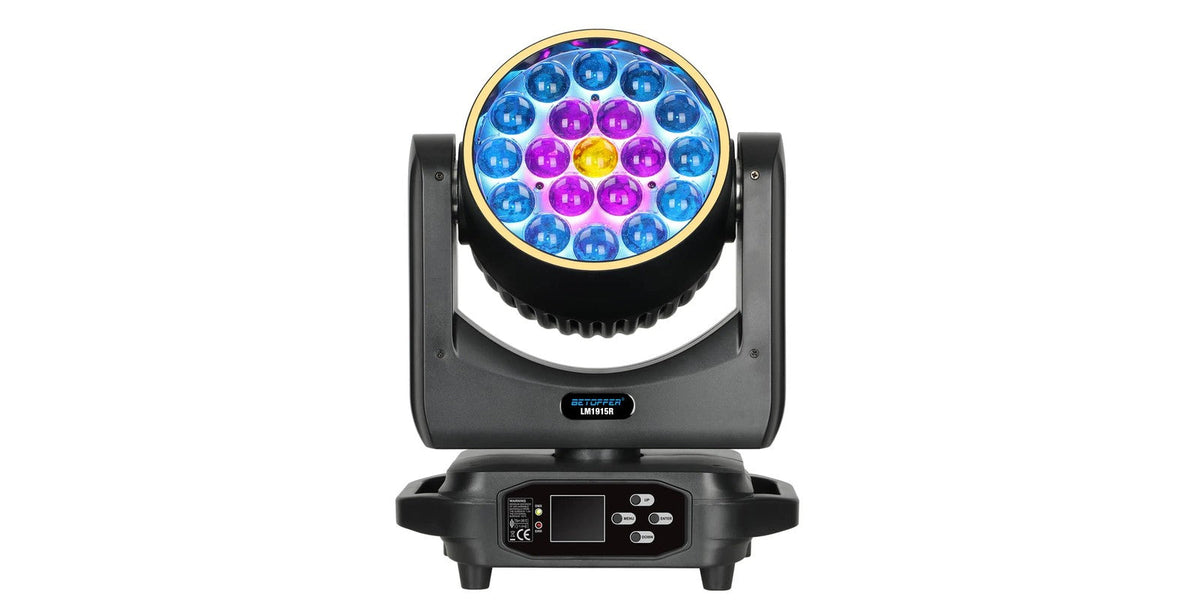
The examples above use eight LM1915R standard-version wash moving heads as the dependable base system. These are moving heads, not static PAR lights; they can remain in fixed positions during assemblies and speaking scenes. For expanded productions, add either four BSW200 fixtures for a broader set of compact spot, beam, and wash effects or two BSW500 fixtures for higher-output hybrid effects. For a school that needs only fixed coverage, compare suitable static wash fixtures before committing to a moving-head system.

LM1915R — example of the standard-version wash moving head used as the base system
Confirm the basic wash design against the actual stage before adding effects. Eight LM1915R fixtures are an example, not a promise of complete coverage for every auditorium. The optional BSW200 or BSW500 layer adds spot, beam, and wash effects; it does not replace a dedicated profile or followspot when a production needs a sharply defined isolated performer.
BSW200 — optional compact hybrid effects
|
BSW500 — optional higher-output hybrid effects
|
|---|
How Moving-Head Effects Fit Into a School Rig
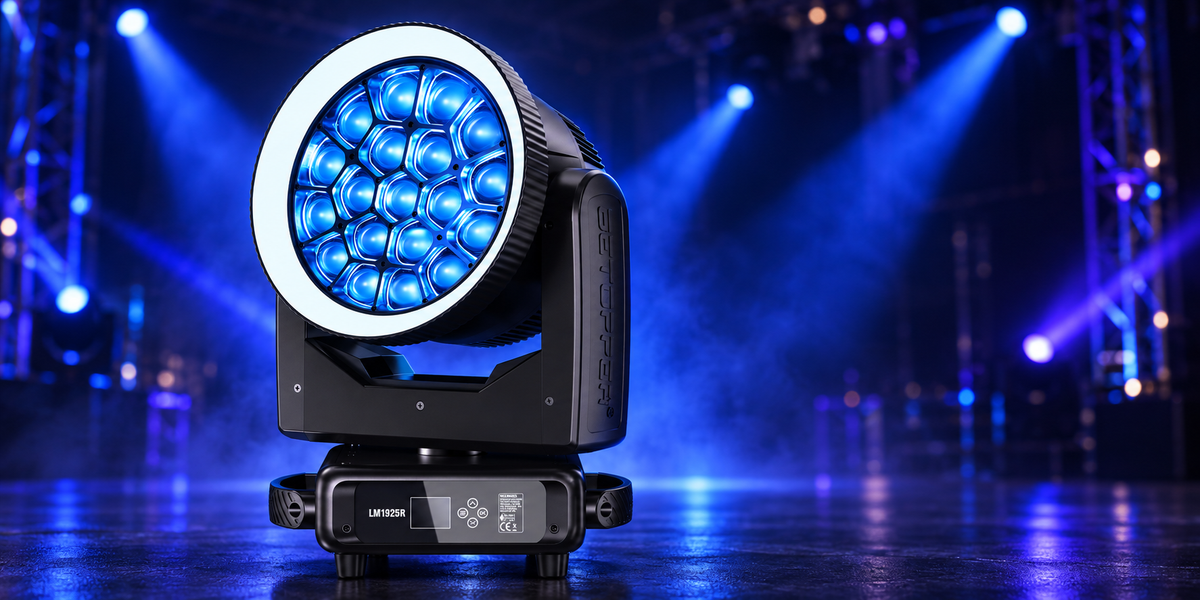
The stage example above shows multiple moving-head beams used together to create a more dynamic production look. In a school auditorium, this type of effect can support musicals, concerts, ceremonies, and transitions, but it should remain an optional layer on top of dependable wash for everyday assemblies and performances. The pictured CLB260-O is shown as a visual example of a multi-fixture stage effect; it is not the LM1915R plus BSW200 or BSW500 configuration specified in the planning examples above.

CLB260-O — visual example of moving-head beams; separate model from the configurations above
Practical notes:
- Build the dependable wash first. Check visibility across the acting area, entrances, and podium position before adding moving effects for special productions.
- Use movement, narrow beams, and color changes only where they support the cue. The multi-beam look shown above is appropriate for higher-energy production moments, while assemblies and speaking scenes should use calmer, stable lighting. Have qualified staff establish approved positions and limits so beams stay clear of audience sightlines and sensitive stage areas.
- Save repeatable scenes and keep a current patch sheet, scene list, and equipment inventory. Student or volunteer operators should work from those approved cues under adult supervision.
A Note on Training Student and Volunteer Operators
Train operators on the actual show file: selecting approved scenes, making permitted brightness adjustments, following the cue sheet, and getting help if something goes wrong. Allow time for a supervised rehearsal; training needs vary with the operator and show. Stage blackout must not disable emergency or required safety lighting. House lights may use a separate system and should only be integrated through the venue’s approved controls.
Recommended Betopper Setup for a School Auditorium
For a school auditorium, a Betopper setup built around eight LM1915R wash moving heads (listed on the product page as the LM1915 Series 19×15W wash moving head) — four for front wash and four for backlight — gives you the dependable base layer, and a production layer can be added with either four BSW200 hybrids or two BSW500 hybrids.
Tier 1 — Basic stage wash (assemblies and simple plays)
| Role | Recommended fixture | Quantity | Key specifications (from the product page) |
|---|---|---|---|
| Front wash | Betopper LM1915 Series 19×15W Wash Moving Head with Halo Ring | 4 | Light source: LM1915R: 19×15W RGBW LEDs + 66×0.2W RGB LED Strip; Rated power: LM1915R: 250W; Zoom range: 20°–40°; DMX channels: LM1915R: 15 / 24 / 32CH |
| Backlight | Betopper LM1915 Series 19×15W Wash Moving Head with Halo Ring | 4 | Light source: LM1915R: 19×15W RGBW LEDs + 66×0.2W RGB LED Strip; Rated power: LM1915R: 250W; Zoom range: 20°–40°; DMX channels: LM1915R: 15 / 24 / 32CH |
Quantity basis: the configuration table already in this article (8 × LM1915R standard version: 4 for front wash and 4 for backlight).
Tier 2 — Expanded production, option A (musicals, concerts, ceremonies)
| Role | Recommended fixture | Quantity | Key specifications (from the product page) |
|---|---|---|---|
| Spot / beam / wash effects layer | Betopper BSW200 200W Spot Beam Wash Hybrid Moving Head Light | 4 | Light source: 1 White LED +24x0.2W RGB LED; Power: 240W; Beam angle: 7°-21°; Channel mode: 23CH |
Quantity basis: the same table in this article (basic example plus 4 × BSW200). Add these on top of Tier 1; they do not replace the base wash.
Tier 3 — Expanded production, option B (higher output)
| Role | Recommended fixture | Quantity | Key specifications (from the product page) |
|---|---|---|---|
| Higher-output spot / beam / wash effects layer | Betopper BSW500 500W CMY + CTO Spot Beam Wash Hybrid Moving Head Light | 2 | Light Source : 400W; Beam Angle : 2.5°~19° |
Quantity basis: the same table in this article (basic example plus 2 × BSW500).
Betopper sells the LM1915R wash moving head, the BSW200 and the BSW500 hybrid moving heads individually; check current availability and specifications on each product page, and confirm final fixture counts against your actual stage before ordering. Installation, overhead work and electrical tasks should be carried out by qualified personnel.
Frequently Asked Questions
Do we need moving heads, or is a basic wash enough?
A suitable fixed wash may be enough for assemblies and straightforward plays. Moving heads are useful when the production benefits from changing coverage or movement effects. The eight-fixture LM1915R example provides the base wash; add either four BSW200 fixtures or two BSW500 fixtures only when the production needs a separate effects layer. Evaluate dedicated spot or profile fixtures separately if the script calls for precise isolation.
Can students safely operate this equipment?
Trained students can recall approved scenes under adult supervision once the system has been installed and checked by qualified personnel. Simple buttons help with operation, but they do not remove the need for training, rehearsal, or a responsible adult. Students should know which controls they may use and when to stop and seek help.
How durable is this equipment for repeated use and storage?
Service life depends on operating conditions, maintenance, transport, and storage. Follow the exact model’s manual, use suitable protective cases, and have staff inspect equipment before reuse. Do not treat a general durability claim as a guarantee of a particular lifespan or assume accidental damage and improper storage are covered by warranty.
What's Betopper's warranty and support like for schools?
Betopper stage lights carry a 24-month limited warranty from the original purchase date, subject to the published terms and exclusions. For covered quality issues, the first 12 months provide a replacement product or parts depending on the case; months 13–24 provide replacement parts. Contact service@betopperdj.com with proof of purchase and photos or video of the problem. The team will assess the claim and advise the next steps, including any return requirements. Plan support requests early rather than assuming an advance replacement will arrive before a performance.
Betopper offers stage lighting and technical support for customers planning new systems or expanding existing setups. Share your auditorium dimensions, current equipment, and typical productions with our team, and check the current product pages and warranty terms before purchasing.
Explore: LM1915 series · BSW200 · BSW500 · Warranty Policy · Return and Refund Policy

Laisser un commentaire
Tous les commentaires sont modérés avant d'être publiés.
Ce site est protégé par hCaptcha, et la Politique de confidentialité et les Conditions de service de hCaptcha s’appliquent.