
Introduction
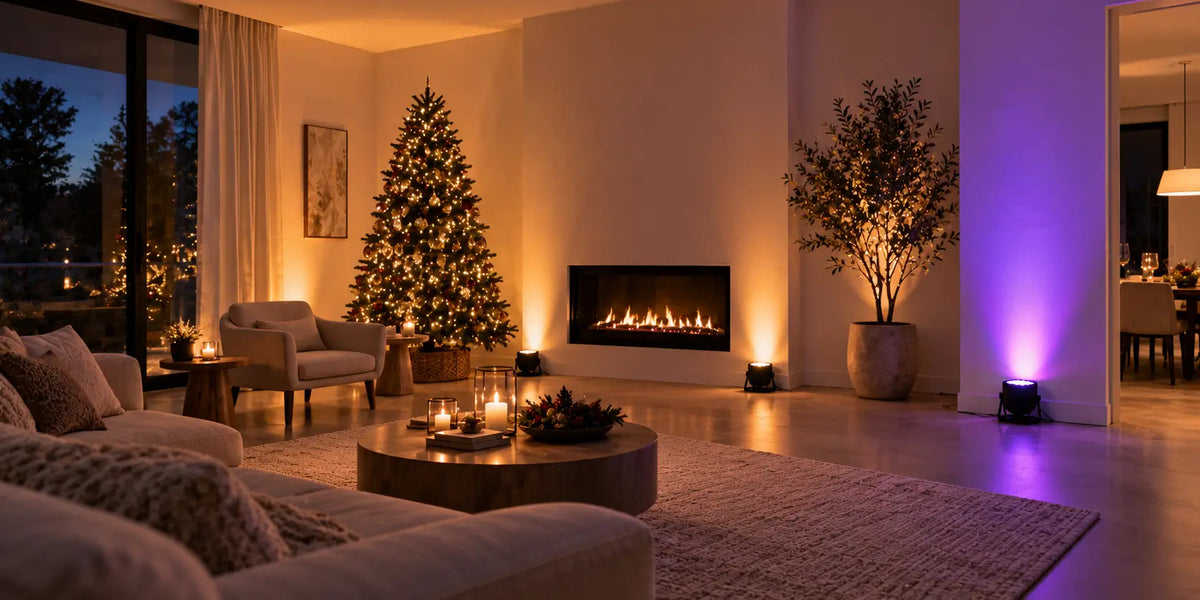
It's 7 p.m. and the guests are ten minutes away. The food is ready, the playlist is queued, and the living room still looks like a Tuesday night: harsh overhead light, flat shadows, and a tree that barely stands out.
The fix is rarely more lights. It's better-placed lights. A room lit in three simple layers, a warm base, a few accents, and one party effect, looks more polished than a room full of bright bulbs, and you can build it in under an hour. The same approach works for Christmas, Halloween, and New Year's Eve with only a few changes.
Here, we walk through how to read your space, build the layers, adapt them for each holiday, and change the lighting as the night moves from dinner to dancing.
Quick Answer
- Base: Turn off the overhead light. Use warm white (around 2700–3000K) at low brightness.
- Accents: Light the tree, table, or backdrop from the side, not straight on.
- Party effect: Add one color or motion effect when the music picks up, not before.
- Swap by holiday: Keep the base. Change only the color and the effect.
Start with Your Space: How Much Light Does a Home Party Really Need?
Most people light a party by making the room brighter. What works better is deciding what you want guests to look at, and where they'll spend the evening.
Walk through the room and mark three areas:
- The perimeter: walls, corners, and windows. Lighting these makes a room feel larger.
- The focal points: the tree, dining table, fireplace, or a photo backdrop.
- The activity area: where people will dance, play games, or count down.
A practical starting point for one room is three to five lights: one or two for the base, two or three for accents, and one for effects. Add more only if a corner still feels empty.
What changes by space
- Small living room: Focus on the walls and the main gathering spot. A few lights around the edges are usually more useful than several lights pointed into the center of the room.
- Open-plan room: Split it into dining, conversation, and dance zones. Each zone doesn't need the same brightness.
- Basement or garage: You have more freedom for strong color and effects, especially around a dedicated dance area.
- Backyard or patio: Check power access, weather exposure, furniture, and walkways before deciding where lights go.
Light the room at different heights. Ceiling light alone flattens faces and hides decorations. Adding light at floor level, table level, and on the walls gives the room depth.
Plan for power and cables. Count your outlets before you buy anything. Keep cables along walls, use tape or cable covers across walkways, and never run cords under rugs. If a light will be used outdoors, make sure it and the extension cord are rated for outdoor use.

Build the Atmosphere with Three Simple Lighting Layers
Each layer has a different job. You can build them one at a time.
Layer 1: Ambient Light for the Base Mood
Ambient light is the soft glow that fills the room. Turn the overhead light off first, because it lands on faces from directly above and creates harsh shadows.
- Use warm white, roughly 2700–3000K. It flatters skin, makes food look better, and reads as "cozy."
- Keep it dim. As a starting point, run ambient light at about a third to half of full brightness. A room that feels slightly dim while you're setting up usually feels right once guests arrive.
- Wash the walls. Placing a light on the floor a foot or two from a wall and aiming it upward creates a soft glow that makes the whole room feel warmer and taller.
Layer 2: Accent Light for the Tree, Table and Decor
Accent light tells guests where to look. The goal isn't to make everything bright. It's to create depth between the background and the details.
- Light from the side. Aiming a light straight at a decoration flattens it. An angle brings out texture.
- Keep the tree glowing, not glaring. Push some string lights deep toward the trunk for depth, and keep the room around the tree dimmer so the tree stands out.
- Match your color temperatures. Warm string lights next to cool white lights look mismatched, especially in photos. Pick one family and stick with it.
- Hide the source. Tuck lights behind plants, furniture, or shelves so guests see the glow, not the bulb.
Layer 3: Party Effects for Motion and Color
Effects change the mood when the party gets going. They work best when the first two layers are already in place.
- Use one effect at a time. Several competing colors and movements tire people out fast.
- Save it for the moment. Dancing and the countdown are what effects are for.
- Avoid fast strobing. Rapid flashing can be uncomfortable for many guests and can trigger seizures in people with photosensitive epilepsy. Keep flash rates slow, and warn guests if you use it.
A useful rule: the quieter the activity, the simpler the lighting. The more energetic the activity, the more movement you can add.
Warm White vs Color-Changing: Which Should You Use?
You don't need to choose. Use warm white for the base and color for the moments.
| Warm White | Color-Changing | |
|---|---|---|
| Best for | Dinner, decor, photos | Dancing, Halloween, countdowns |
| Atmosphere | Warm and natural | Energetic and dramatic |
| Best time to use | Arrival and dinner | Party and late night |
| Watch out for | Can feel flat on its own | Can overwhelm a small room |
Match the Lighting to Christmas, Halloween & New Year's
The same base works for all three. What changes is the palette, the intensity, and the timing.
Christmas: Warm, Cozy and Photo-Ready
- Stay warm. Warm white with small touches of amber, red, or green. Let the tree and table carry the room.
- Dim the room, not the tree. A slightly darker room makes the tree lights and candles look brighter.
- Plan for photos. Put the brightest source in front of or beside faces rather than overhead, and skip the flash if you can. Phone night modes handle warm light better than flash does.
Halloween: Spooky Color and Blacklight Effects
- Go dark first. Dark rooms make color look stronger. Bring the base light down low, then add one or two colors. Purple, green, and orange are instant signals.
- Try UV (blacklight). It needs a dark room to work, and it makes fluorescent materials glow: white clothing, neon paint, highlighter-marked decorations, and even tonic water, which glows blue under UV. Don't stare directly into the light source.
- Be careful with fog. Fog or haze can set off some smoke detectors and hide trip hazards. Keep it light, ventilate the room, and keep it away from detectors.
- Light the entrance. Keep the steps, path, and doorway clearly lit so guests can arrive safely.
New Year's Eve: Sparkle, Motion and Countdown Energy
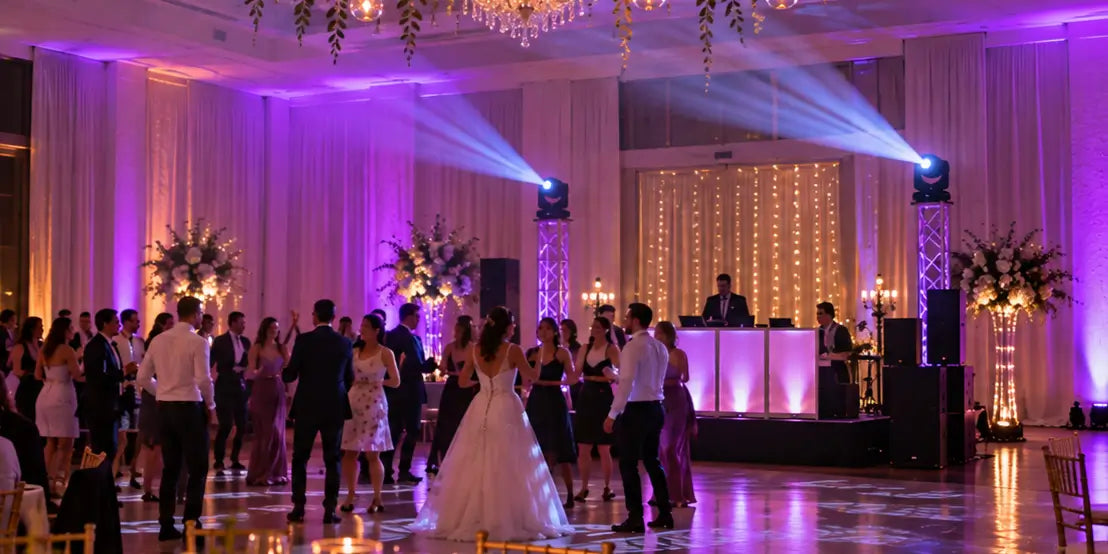
- Build toward midnight. Start with restrained white or warm light, then add color and movement over the evening.
- Use reflective surfaces. Metallic curtains, foil backdrops, and a mirror ball scatter light for very little effort. A mirror ball needs only a single spotlight.
- Make a photo corner. A backdrop with soft, even light from both sides beats a phone flash.
- Save the strongest look for the countdown, then return to a comfortable level afterward.
Quick Setup by Holiday
| Christmas | Halloween | New Year's Eve | |
|---|---|---|---|
| Base light | Warm white, dimmed | Low and dark | Restrained white or warm |
| Accent focus | Tree, table, mantel | Props, fluorescent decor | Backdrop, photo corner |
| Effect layer | Soft or none | UV plus one color | Color and motion at midnight |
| Main mood | Cozy | Dramatic | Celebratory |
4. From Dinner to Dancing: Program the Lights Around the Party
A party isn't one moment. If the lighting never changes, the room feels flat by the end of the night. Plan three or four scenes in advance and switch between them.
| Party stage | Goal | Suggested look |
|---|---|---|
| Arrival and dinner | Welcoming, comfortable | Warm white, dimmed, no effects |
| Mingling and games | Clear and lively | Slightly brighter accents, light color |
| Dancing | Energetic | Lower base, one color effect |
| Countdown or finale | A clear moment | Strongest color or pulse |
| Winding down | Relaxed again | Back to warm white, dimmed |
Some tips for making the shifts smooth:
- Change one thing at a time. Raise the accents first, then add color, rather than switching everything at once.
- Do a run-through before guests arrive. Step through each scene once to spot lights that are too bright, corners that are too dark, and transitions that feel abrupt.
- Use timers or smart plugs for simple changes, so you don't have to leave the party to adjust the lights.
- Come back down. After the peak moment, return to a comfortable level so the room doesn't feel overstimulated.
A Simple Betopper Setup for Home Holiday Parties
For a small apartment and a simple dinner, a couple of lamps and warm string lights may be all you need. A dedicated setup starts to make sense when you're hosting a larger group, want stronger color and effects, or want to use the same kit across several holidays or outdoors.
Here's a compact kit built around the three layers:
| Light | Role | Key specs | Setup time | Best for |
|---|---|---|---|---|
| LPW0450 | Ambient + accent | 4×50W WW/CW COB, adjustable white 3000K–6500K, 16-bit dimming, DMX512, Auto, Sound Active and Master/Slave modes, IP65 | About 10 min | Christmas, dinner, decor |
| LPD001 | Color + party effects | 9×18W RGBWA+UV, about 6 hours of battery, 2.4GHz wireless DMX, IP65 | About 10 min | Halloween, New Year's, backyard parties |
| DMX controller | Scene control | Changes several lights together | About 10 min | Multi-light setups |

Example configurations
| Setup | Example configuration | Suitable for |
|---|---|---|
| Warm and simple | 2–4 × LPW0450 | Christmas dinner, small gatherings |
| Holiday party | 2–4 × LPW0450 + 2 × LPD001 | Living room, basement, garage |
| Outdoor party | LPW0450 + LPD001 | Patio or backyard |
How to set it up
- Establish the base. Place the LPW0450 around the room edges or near the main decorations, and set it to a warm white.
- Add the effect layer. Position the LPD001 near the activity area, keeping stands and cables away from walkways and eye level.
- Set three scenes. Prepare a dinner look, a party look, and a countdown look before guests arrive. You don't need a complicated show for a home event.
You don't need every light in every scene. The IP65 rating also means the same kit can move to a patio or backyard, as long as the weather and operating conditions suit that rating.
Common Home Party Lighting Mistakes
- Leaving the overhead light on. It flattens faces and washes out decorations. Turn it off and build from lower, warmer sources.
- Running every effect at once. Pick one and save it for the right moment.
- Aiming lights at eye level. Aim at walls, decorations, or a backdrop instead.
- Mixing color temperatures. Warm and cool white together look mismatched, especially in photos.
- Ignoring cables, heat, and placement. Keep cables along walls and lights clear of candles, curtains, and other flammable materials.
- Skipping the run-through. A few minutes before guests arrive saves you from fixing problems mid-party.
FAQ: Lighting a Holiday Party at Home
How many lights do I need for a small party?
For one room, three to five lights is a practical starting point: one or two for the base, two or three for accents, and one for effects.
Can I use the same setup for Christmas, Halloween, and New Year's Eve?
Yes. Keep the same base and change the color, intensity, and timing for each occasion.
What color temperature is best for a holiday party?
Warm white, around 2700–3000K, works best for dinner, decor, and photos. Save cooler light and color for later in the evening.
Can I light a party without running a lot of cables?
Yes. Battery-powered lights, timers, and wireless control reduce the number of cables across the room. Whatever you use, keep cords along walls and off walkways.
Can I use party lights outdoors?
IP65-rated lights can suit patio or backyard setups, but always consider the actual weather, placement, and power requirements, and follow the operating instructions.
Do I need a DMX controller?
Not always. For a simple one-room setup, built-in modes can be enough. A controller is useful when you want several lights to change together as the party moves from dinner to dancing, or when you want repeatable scenes throughout the night.
Conclusion: Light Your Holiday Party the Simple Way
Great party lighting doesn't need a complicated rig. Turn off the overhead light, build a warm base, add a few accents where you want people to look, and bring in color when the music picks up. Change one layer at a time, and the same setup carries you through Christmas, Halloween, and New Year's Eve.
If you'd like a ready-made starting point, see our LPW0450 for the base layer and LPD001 for color and effects.

Dejar un comentario
Todos los comentarios se revisan antes de su publicación.
Este sitio está protegido por hCaptcha y se aplican la Política de privacidad de hCaptcha y los Términos del servicio.