

Introduction
If you're a wedding DJ, you've probably faced this situation:
You want your setup to look more professional —
but every upgrade seems to mean spending more money.
Add two more lights. Upgrade to moving heads. Buy a full lighting package.
Before you know it, you've invested thousands —
yet your setup doesn’t necessarily look that much better to your clients.
And that’s the frustrating part.
Because wedding clients don’t care how much you spent.
They care about how the room feels, how the dancefloor looks, and whether the experience feels premium.
So the real question becomes:
How do you create a high-end wedding lighting setup — without overspending on gear you don’t actually need?
In this guide, we’ll break down exactly how DJs can cut up to 30% of their lighting costs, by building smarter setups, choosing the right fixtures, and focusing on what actually creates impact.

Why Most Wedding DJs Overspend on Lighting
Here’s the truth most DJs don’t realize early on:
You don’t lose money on lighting because equipment is expensive —
you lose money because your setup isn’t efficient.
Let’s break down where that extra 30% of cost usually goes.
- Buying More Gear Than You Actually Use
- Overlapping Fixtures That Do the Same Job
- No Clear “Impact Strategy”
The 30% Rule — What Actually Matters in Wedding Lighting
Reducing cost without reducing impact is not about using fewer lights.
It’s about understanding where lighting actually creates value in a wedding environment.
In practice, most of the perceived quality of a setup comes from three priorities:
1. Focus — Where Attention Is Directed
In a wedding setting, lighting is not evenly experienced across the room.
Attention naturally concentrates on:
- The dancefloor
- The couple
- Key moments (first dance, entrances)
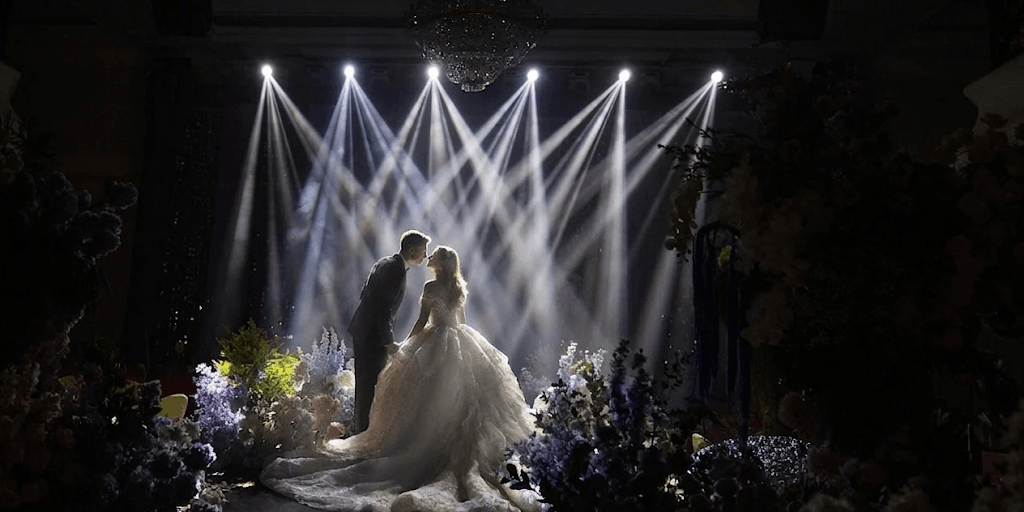
A setup that clearly defines these focal areas will feel intentional and professional — even with fewer fixtures.
By contrast, evenly distributed lighting often results in a space that feels bright, but visually unfocused.
Effective setups prioritize where people look, not how much space is lit.
2. Atmosphere — How the Room Feels
Beyond focal points, what clients perceive most is the overall atmosphere of the room.
This is shaped by:
- Consistent color across fixtures
- Balanced ambient lighting
- Clean, controlled coverage of walls and background areas
A well-built atmosphere makes the venue feel complete and elevated.
Importantly, this does not require a large number of lights —
it requires cohesion and placement.
Inconsistent or fragmented lighting reduces perceived quality, regardless of quantity.
3. Flexibility — How Many Moments One Setup Can Cover
A wedding is not a single lighting state. It evolves:
- Ceremony
- Dinner
- First dance
- Open dancefloor
An efficient setup is one that can adapt across these moments without requiring additional equipment.
This is where many DJs overspend — building separate layers of lighting for different phases, instead of using fixtures that can transition between them.
The more roles a fixture can cover, the lower the total system cost.
In practical setups, this often means choosing fixtures that can cover multiple roles.
For example, hybrid moving heads like the Betopper BSW200 (Beam / Spot / Wash) allow you to handle focus, movement, and ambient effects with a single fixture — reducing the need for multiple lights.

How to Save 30% Without Losing Impact
Once your setup is structured correctly, saving money is not complicated.
It comes down to three practical decisions.
1. Replace Quantity with Positioning
Most DJs try to improve their setup by adding more lights.
A better approach is to place fewer lights more intentionally.
For example:
- Two moving heads covering the dancefloor from opposite sides
- PAR lights evenly spaced along key walls
This creates:
- Clear visual focus
- Balanced coverage
- No wasted output
Instead of:
- Lights overlapping
- Areas being over-lit while others are ignored
Better positioning often replaces 2–3 extra fixtures.
2. Choose Fixtures That Do More Than One Job
One of the fastest ways to overspend is buying lights for single purposes.
Instead, prioritize fixtures that can handle multiple roles:
- Beam + wash + spot
- Static + movement
- Ambient + effect
This allows you to:
- Use the same fixtures across different moments
- Reduce the total number of lights needed
One versatile fixture can replace multiple single-function units.
3. Invest in Output, Not Quantity
Not all lights contribute equally to the final result.
Higher-output fixtures:
- Cover more space
- Remain visible in brighter environments
- Reduce the need for additional units
Lower-output fixtures often lead to:
- Adding more lights to compensate
- Increased cost without proportional impact
One strong fixture is often more effective than several weaker ones.
Common Mistakes DJs Make (That Waste Money)
Even with a good setup, small mistakes can quickly cancel out your efficiency.
Here are the most common ones.
1. Too Many PAR Lights in the Same Area
Stacking PAR lights on the same wall or floor doesn’t increase impact.
It just:
- Over-saturates the space
- Wastes output
- Adds unnecessary fixtures
2. Mixing Fixtures with Different Color Output
Not all lights produce the same white or color tone.
When mixed:
- Colors don’t match
- The setup looks inconsistent
- The overall quality drops
3. Overlapping Functions
Using multiple fixtures to do the same job:
- PAR lights + wash effects in the same area
- Multiple effects competing on the dancefloor
Result:
- No clear visual focus
- No real improvement in impact
4. Ignoring Control (No DMX or Programming)
Running everything in auto or sound mode leads to:
- Random movement
- Inconsistent transitions
- Less professional results
🔎 FAQ — Wedding DJ Lighting Setup
1. How many lights do I really need for a wedding DJ setup?
For most weddings, 2–4 moving heads and 4–6 PAR lights are enough to create a professional look. More fixtures don’t necessarily increase impact.
2. Do I need moving head lights for weddings?
Yes. Moving heads create beam and movement, which are key to making the dancefloor look dynamic and high-end.
3. How many uplights are needed for a wedding?
Typically 6–10 uplights are enough to cover walls and create a balanced atmosphere, depending on venue size.
4. Can I run a wedding lighting setup without DMX?
You can, but DMX control gives you cleaner transitions and more professional results. It’s highly recommended for consistent performance.
5. What’s the biggest mistake DJs make with lighting?
Buying too many fixtures without a clear structure. This increases cost without improving how the setup looks.
Conclusion
A great wedding lighting setup isn’t about how many lights you bring.
It’s about what people see and feel in the room —
a defined dancefloor, a clean atmosphere, and lighting that supports every moment of the night.
When your setup is built this way, it looks more professional, runs more efficiently, and costs less to maintain.
If you’re refining your wedding setup or building a new one, you can explore practical setup options and fixture types here: https://betopperdj.com/

Dejar un comentario
Todos los comentarios se revisan antes de su publicación.
Este sitio está protegido por hCaptcha y se aplican la Política de privacidad de hCaptcha y los Términos del servicio.