




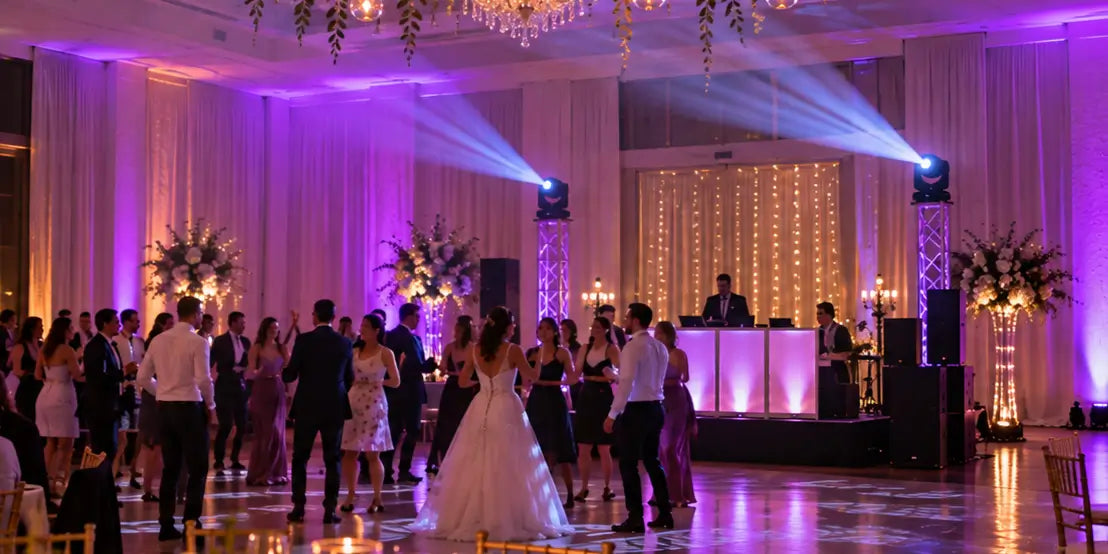
You don't need a rental company's long equipment list to light a wedding reception well. Many reception venues — from a 100-guest backyard tent to a 200-guest ballroom — can use the same three-part framework: ambient uplighting around the room, moving-head effects on the dance floor, and one DMX controller tying both together on cue. The final fixture count should be adjusted for room dimensions, ceiling height, ambient light, and the desired effect. Here's a practical starting configuration, with approximate pricing that should be confirmed before purchase.
Why Three Parts Cover the Core Lighting Jobs at Many Receptions
Wedding lighting quotes can overwhelm couples and DJs alike, with long equipment lists, unfamiliar model numbers, and widely varying totals. In practice, many 100–200 guest receptions have three core lighting jobs: wash the walls and background in color, give the dance floor movement and energy once dinner ends, and switch smoothly between the two as the night moves from dinner to first dance to open dancing. That is the brief behind the three-part framework below; larger, taller, or unusually bright rooms may need additional fixtures.
The 3-Part Configuration
|
Piece |
Setup |
Approx. Cost |
What It Does |
|
1. Room Uplighting |
~$1,374 |
Placed around the room's perimeter to color the walls and backdrop — the fastest way to transform a plain reception hall |
|
|
2. Dance Floor Effects |
$398 |
Mounted on stands behind or beside the DJ booth to add motion and beam effects once dancing starts |
|
|
3. DMX Control |
1× 192-channel DMX controller |
~$190 |
Links Pieces 1 and 2 into scenes you can switch through with a single button as the timeline moves along |
Based on the listed estimates, the configuration totals roughly $1,960 — equipment you own outright and can redeploy at future events rather than renting each time. For a working mobile DJ or event company, the equipment cost per booking can fall as the setup is reused. Confirm current product prices and availability before purchasing. The LM0740 package includes the core connection accessories shown above, which makes it easier to plan the moving-head portion of the setup.

Sample Light Plot for a Wedding Reception
Layout notes:
- Choose wireless, battery-powered PAR fixtures for Piece 1 whenever possible. Running cable across a ballroom floor for uplighting is one of the most common setup headaches — battery units let you place and forget in under thirty minutes.
- Keep the moving heads at the edge of the dance floor, not dead center, so stands don't end up in the middle of the couple's first-dance photos.
- Give the head table its own one or two warm-toned PAR fixtures, separate from the rest of the room, so the color palette doesn't read as flat and uniform all night.

A Scene-by-Scene Program for Your Wedding Timeline
A practical wedding program can be built around five scenes. Save each one on your DMX controller in advance, and call them up as the MC moves through the schedule:
- Cocktail Hour / Dinner: warm white and low-saturation amber, moving heads static or on a very slow breathe — this is background ambiance, not a show.
- First Dance: soft pink, purple, and white held on the dance floor, moving heads focused and steady, no fast movement.
- Dancing Opens: moving heads shift to a medium-speed cross-sweep with saturated PAR color as the floor fills up.
- Peak Dancing: full rig at higher speed, faster color changes timed to the beat — this is where the moving heads should do the most work.
- Photos / Send-Off: back to soft, static white light. No strobing, so send-off photos come out sharp.
One programming note worth remembering: don't make the moving heads the visual centerpiece of the entire reception. Soft, well-placed uplighting and restrained movement generally read as more polished at a wedding than constant flashing — save the higher-energy looks for the peak dancing scene and let the rest of the night stay understated.
Frequently Asked Questions
How many lights does a wedding reception actually need?
For many 100–200 guest receptions, six PAR fixtures for room uplighting plus two moving heads for the dance floor can be a useful starting point. Larger or taller rooms, brighter ambient conditions, or more dramatic creative goals may require additional fixtures.
Do I need wireless, battery-powered uplights?
It isn't mandatory, but it's strongly recommended. Running power to every fixture around a ballroom is time-consuming and creates trip hazards along guest walkways. Battery-powered units cut setup time dramatically and are safer around a crowd.
Can this same setup be reused for other events?
Yes. The same 3-piece configuration works just as well for corporate parties, milestone birthdays, and small festivals, which makes it one of the most versatile starting configurations for a mobile DJ or event lighting business.
How fast can Betopper ship ahead of a wedding date?
Betopper stocks inventory in US and European warehouses, with typical delivery in 2–7 business days — useful for last-minute additions ahead of peak wedding season.
Betopper is the independent, direct-to-consumer brand of Big Dipper, one of China's largest exporters of stage lighting equipment, with products verified across dozens of markets worldwide. Every fixture is engineered to the same OEM manufacturing standards used by leading lighting brands and sold factory-direct, cutting out the distributor and retail markups that inflate comparable gear elsewhere. Betopper holds a 4.8-out-of-5 rating on Trustpilot from 366 verified reviews.

Leave a comment
This site is protected by hCaptcha and the hCaptcha Privacy Policy and Terms of Service apply.